
Nick Beim

Thoughts on the Economics of Innovation

Arca: An AI-First Platform for Human-First Wealth Management

First Arca board meeting: Nick Beim, Jason Wenk, Rron Rexha and Bill McNabb

Rebuilding a services organization bottoms-up with AI can be an extraordinary way to create value, particularly if it means getting rid of legacy technology, creating agentic workflows that enable individuals to focus on their highest-value work and automating almost everything else. What makes the current AI revolution particularly exciting is that new AI capabilities can simultaneously enable step-function changes in the scale and nature of value these organizations can deliver.

Rron Rexha is weaving together all these threads in his new company Arca, which is rethinking wealth management to generate better financial outcomes for consumers, improve the performance of financial advisors and create an organization that is far more efficient and higher-growth than anything the industry has seen. Rron joined us as an Entrepreneur in Residence a few years ago to craft this idea, and he has just launched the company, letting the world know that since starting wealth management operations 7 months ago, the company already manages over $1 billion in customer assets, has raised $64 million and is growing very rapidly.

Importantly, Arca is not seeking to replace financial advisors with AI. I believe that one of the big mistakes Silicon Valley has historically made in wealth management is trying to automate away the financial advisor on the assumption that this is what consumers want, initially with roboadvisors and most recently with AI advisors. In fact, consumers have shown a remarkably strong preference to work with people to help them manage their money for reasons of trust, empathy, understanding and accountability. Roboadvisors were an exciting new innovation, but ultimately became a niche product. There are certainly customer segments where roboadvisors and AI advisors are best-fit products, and these will grow over time, but today they are still small.

What’s revolutionary about Arca is that it is knocking down almost all of the technology the industry is using today and building new capabilities and automation bottoms-up with AI from first principles. This should enable vast improvements in advisor efficiency. Today most advisors spend about 50% of their time stuck in administrative tasks rather than working with clients or growing their business because of the limitations of the existing industry technology stack, which consists of siloed point solutions that communicate poorly with each other. ARCA’s unified technology stack will break down these boundaries, pool all of an advisor’s data, automate most workflows and do much of an advisor’s administrative work, research and analysis in minutes, giving them back most of this time to serve more clients and grow their businesses. 

Arca will also make advisors far more effective by bringing world class financial judgment to every contextualized financial decision they make. This will enable optimization of financial planning, portfolio construction and portfolio management to the needs, risk tolerances and tax profiles of their clients to a degree that has not previously been possible. Combined with custom indexing and highly personalized behavioral coaching, this will lead to better financial outcomes for Arca’s customers.

The AI-first approach will create better financial outcomes not only for Arca’s clients, but for its financial advisors, who will be free of the highly limited technology they have to work with today. Working at Arca, they will be able to serve more clients, which provides significant financial upside. They will also be able to deliver better outcomes for these clients, which enables them to expand these relationships and improve retention. A key reason Arca has grown so rapidly is that advisors, who understand the current technological limitations of the industry better than anyone, have expressed a strong preference to work at the company and have voted with their feet to join it.

From a macro perspective, Arca is a building a highly productized form of services organization, where human agents, in this case financial advisors, remain the core of the business, but they are far more efficient and effective because they are empowered by a unified AI foundation that replaces the tangled mess of technology they use today and brings them a much higher degree of financial intelligence than would otherwise be possible. 

This should make the company far more scalable, higher-margin and higher-growth than traditional services organizations in wealth management. While existing RIA’s, wirehouses and broker dealer networks can apply AI point solutions on top of their legacy technology stacks, they won’t be able to achieve similar scalability, margins or growth without replacing these stacks altogether, which is very difficult to do, especially for highly-scaled organizations. This type of wholesale rebuild is most effective when it is done from scratch by a small company with an outstanding AI-first engineering team.  

Rron has brought together an exceptional group of advisors to help him build the company, including Jason Wenk, the founder and CEO of Altruist; Bill McNabb, the former Chairman and CEO of Vanguard; Morgan Housel, the leading expert on the psychology of money; and Peter Crawford, the former CFO of Charles Schwab. 

It’s early days for Arca, but given the advantages in performance, scalability and growth that its AI-first approach confers, I believe it has a lot of ground to take in the wealth management industry in the decades ahead. 

(For those who are curious, “arca” comes from Latin and was the holding place for people’s most valuable assets. It’s where heirlooms, money, and documents were kept safe.)
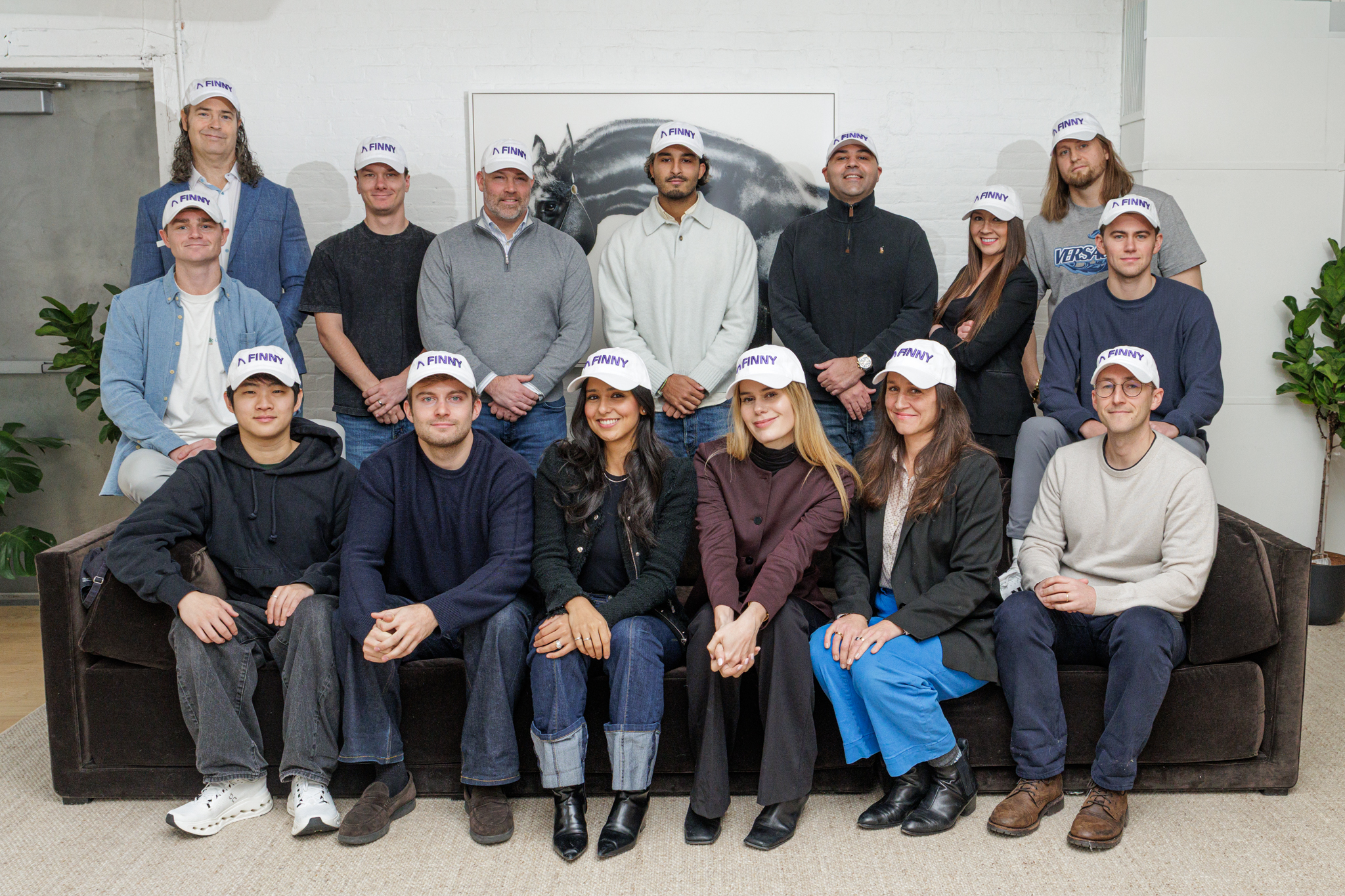

FINNY: Unlocking Organic Growth in Wealth Management

It’s rare when an early-stage B2B startup sees explosive organic growth out of the gate, with 80%+ of customers coming from inbound demand, close rates of 70%+ and sales cycles of 1-2 days. These are signs of exceptional product value, and that’s what FINNY, an AI-driven prospecting platform for wealth management, has delivered with its initial product.

FINNY enables financial advisors to find and engage potential clients who are the best fit for their practices and most likely to convert. And it delivers big: since its launch, FINNY has generated $7.7M in new client assets per advisor annually, which is a big number relative to the product’s low cost. At a 1% annual fee, this translates into $77K in high margin revenue per advisor annually for 20+ years.

Scalable organic growth is the holy grail of the wealth management industry, something that every advisor seeks and few experience. Existing growth methods are painful because they are either incredibly expensive (custodial referrals) or incredibly time consuming (traditional lead gen). The result is an industry that struggles significantly with growth. FINNY brings scalable organic growth to financial advisors by enabling them to reach out to high-conversion targets in a customized yet highly automated, continually optimized way. A few hours of setup launches a campaign that puts high-value prospects on an advisor’s calendar.

The kind of success FINNY has seen is only possible with an exceptional team. FINNY’s founders – Eden Ovadia, Victoria Toli and Theo Janson – are AI engineers who combine deep domain expertise in wealth management, top Silicon Valley product experience and an ability to execute very rapidly. They have already won every major award in their industry – the 2025 Wealthies, the 2025 Morningstar Fintech Annual Showcase, the 2025 Datos Impact Awards, the ThinkAdvisor Luminaries Awards – and were recently named part of the Forbes 2026 list of 30 Under 30. They have emerged as clear thought leaders in the industry on how to accelerate organic growth.

It’s a privilege and a lot of fun to work with the team. FINNY is our seventh investment in wealth management, where we continue to see big opportunities for new technology companies. In the emerging AI-driven technology stack for financial advisors, FINNY is a must-have component whose significance will grow meaningfully over time. Watch for significant announcements from FINNY in the year ahead.


Dataminr and the Science of Real-Time Information Discovery

Today Dataminr announced a $130m round of financing from a group of leading financial institutions and prominent financial thought leaders including John Mack, Vikram Pandit, Tom Glocer and Noam Gottesman.  

A number of friends have asked me about the company and what I find most interesting about it. This seemed like a good opportunity to highlight a few thoughts. 

What I find most interesting about Dataminr is that in addition to building a business, it is pioneering a new science. The science is real-time information discovery, and it involves sifting through the ever-growing tidal wave of real-time public data to identify and determine the significance of breaking events by their nascent digital signatures, as they happen. Sometimes these events are well-wrapped, for example by someone witnessing an event and tweeting about it, with others providing corroboration. Sometimes they aren’t, with algorithms figuring out what is happening by seeing thousands of facets of something larger. The company has a deep strategic partnership with Twitter that makes this kind of discovery possible. 

This new science is, without a doubt, very cool. It enables one to discover news before it’s news and market-moving information before markets move. It provides a kind of X-ray vision into what is going on in the world in real-time with a filter for what is significant, and to whom. All on the basis of publicly available data.

In a period of five months, Dataminr has become the real-time wire service used almost universally by major news organizations, beating out the next best service by over an hour and discovering troves of unknown unknowns that would never have otherwise come to light. It has become adopted by the lion’s share of leading financial institutions to have access to the frontier of breaking information in real time.  

What’s also interesting is how Dataminr will change the world. In my view most industries that rely on real-time information — an ever-increasing number — will be influenced by it, and some will be transformed by it. The wave of change began in the fields of finance, news and public safety, and I think will move quickly to risk management, security and PR. And undoubtedly to other verticals in ways that are difficult to predict. I am particularly excited about what the company and its technology can do to help save lives in the fields of public safety and humanitarian assistance.  

Dataminr is in the early days of a long journey, but it is already impacting the world in significant ways, and it’s exciting to be a part of.


A Debate about the Future of NY Tech

HotTopics recently hosted an interesting debate moderated by Jeff Glueck about the future of the NY tech scene that I participated in along with Kevin Ryan, Dennis Crowley, Jessica Lawrence, Alfred Lin and Bob Goodman.

Here are the highlights. Some of the big questions we hit were:

-How is the NY technology ecosystem different than Silicon Valley?
-What are NY’s key strengths and challenges?
-Where does NY tech go from here?
-Does NY favor startups that focus on making money over big-swing platforms that defer their focus on revenue?
-In this inning of information technology, what kinds of industries are disrupted by insiders vs. outsiders?

I wish we had had more time to discuss this last question, as it is a very interesting one worth a debate or series of blog posts in its own right.

https://www.youtube.com/watch?v=EYie9hsyO7A&feature=youtu.be&utm_source=Sign-Up.to&utm_medium=email&utm_campaign=25318-64421-Hot+Topics+New+York+Campaign+-+05%2F06%2F2014+


A Discussion With Some of New York’s Most Successful Repeat Entrepreneurs

Some of the most helpful advice in building startups comes from entrepreneurs who have been there and done it successfully multiple times. To try to find and highlight the best advice of this kind, we recently hosted a panel discussion with a group of New York’s top repeat entrepreneurs, including:

-Kevin Ryan: cofounder and Chairman of the Gilt Groupe, MongoDB, Business Insider, Zola
-Brian O’Kelley: founder and CEO of AppNexus, CTO of Right Media
-Fabrice Grinda: founder/cofounder of OLX, Zingy and Aucland

Together these entrepreneurs founded or cofounded 14 companies that are worth over $6.3 billion and currently employ over 3,000 people, which is a pretty astonishing statistic. They have also made over 150 angel investments in 10 continents across almost every technology sector.

It was a great discussion with a lot of wisdom on the subject of what matters most in building a successful company and key mistakes to avoid. We also had a chance to share some thoughts on the future of the New York technology scene.