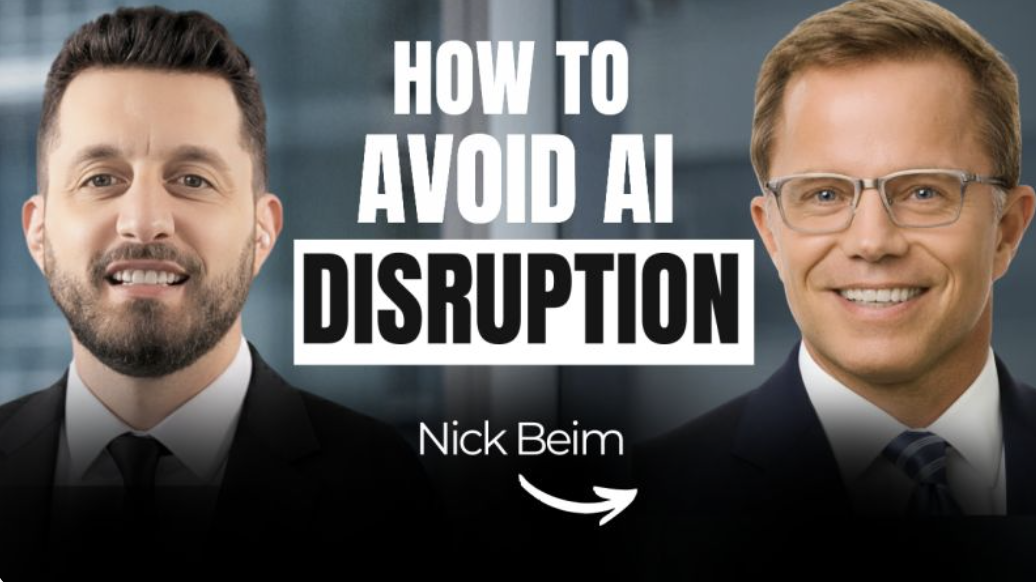
I had an opportunity to speak with David Weisburd on what happens when general intelligence commoditizes, the promise of vertical AI and the impact of AI in wealth management and defense. We also had chance to discuss what I think is one of the most interesting cognitive bias traps in venture investing, which is when pattern recognition – which helps you sift through 95% of investment opportunities with extraordinary efficiency – utterly fails you when it comes to some of the most successful venture investments. Love how they digitally dressed me in a tie for the cover photo :). You can listen to the discussion here.
It’s rare when an early-stage B2B startup sees explosive organic growth out of the gate, with 80%+ of customers coming from inbound demand, close rates of 70%+ and sales cycles of 1-2 days. These are signs of exceptional product value, and that’s what FINNY, an AI-driven prospecting platform for wealth management, has delivered with its initial product.
FINNY enables financial advisors to find and engage potential clients who are the best fit for their practices and most likely to convert. And it delivers big: since its launch, FINNY has generated $7.7M in new client assets per advisor annually, which is a big number relative to the product’s low cost. At a 1% annual fee, this translates into $77K in high margin revenue per advisor annually for 20+ years.
Scalable organic growth is the holy grail of the wealth management industry, something that every advisor seeks and few experience. Existing growth methods are painful because they are either incredibly expensive (custodial referrals) or incredibly time consuming (traditional lead gen). The result is an industry that struggles significantly with growth. FINNY brings scalable organic growth to financial advisors by enabling them to reach out to high-conversion targets in a customized yet highly automated, continually optimized way. A few hours of setup launches a campaign that puts high-value prospects on an advisor’s calendar.
The kind of success FINNY has seen is only possible with an exceptional team. FINNY’s founders – Eden Ovadia, Victoria Toli and Theo Janson – are AI engineers who combine deep domain expertise in wealth management, top Silicon Valley product experience and an ability to execute very rapidly. They have already won every major award in their industry – the 2025 Wealthies, the 2025 Morningstar Fintech Annual Showcase, the 2025 Datos Impact Awards, the ThinkAdvisor Luminaries Awards – and were recently named part of the Forbes 2026 list of 30 Under 30. They have emerged as clear thought leaders in the industry on how to accelerate organic growth.
It’s a privilege and a lot of fun to work with the team. FINNY is our seventh investment in wealth management, where we continue to see big opportunities for new technology companies. In the emerging AI-driven technology stack for financial advisors, FINNY is a must-have component whose significance will grow meaningfully over time. Watch for significant announcements from FINNY in the year ahead.
I had a chance to moderate a great discussion with Chris Hughes, the economist and cofounder of Facebook, about his new book Marketcrafters: The 100-Year Struggle to Shape the American Economy, along with Eddie Fishman and Jessica Brandt. The book examines attempts by both sides of the political aisle to shape or manage markets for political or social ends across many industries – finance, healthcare, pharmaceuticals, semiconductors, aviation, and others. We looked at examples where these efforts had worked well (e.g. the Federal Reserve), where they hadn’t (e.g. government involvement in healthcare) and what lessons could be drawn from history (e.g. the importance of institutional accountability and responsiveness to ever-changing markets). We reviewed recent attempts to shape technology markets (AI, semiconductors) to help achieve geopolitical goals and shared perspectives on how likely they were to be successful. You can listen to the whole discussion here.
This is a great piece of advice that Dylan Parker, co-founder and CEO of Moment, gave to other entrepreneurs in our recent podcast discussion:
Make very clear, very focused, very all-in bets. The most important thing is that you can be wrong, as long as you are wrong quickly and clearly.
Moment is a fixed income infrastructure provider that is off to a very fast start. They made a decision to swing big and try to land whale customers early in the company’s development given how much more advanced their product was than existing fixed income infrastructure. This is something that often doesn’t make sense for startups, as large customers take up immense amounts of time, and it’s often better to hone your product on smaller customers where the stakes are smaller. But given the strategic significance of these customers for Moment and the high demand for new fixed income infrastructure that resulted from the jump in interest rates in 2022, they made a very clear, intentional bet as to whether they could land one of these customers early in their development. It turns out they could, they did, and they now have done so several times. That early bet made a huge difference in the company’s growth trajectory.
I’ve learned a ton from Bill McNabb, the former Chairman and CEO of Vanguard, in our work together at Altruist, Vanilla and two stealth-mode startups. Bill helped build today’s asset management and wealth management industries and saw the incredible power technology could have in shaping the future of both.
I recently had the chance to interview Bill on our Venrock podcast. You can find our discussion here. In it, Bill shares important leadership lessons including the importance of being humble, having a clear definition of success, and knowing what makes a high-performing team. He reveals significant decisions he made during his time at Vanguard, such as having “no layoffs” during a crisis, and highlights the importance of thinking long-term while still being agile.