Vanguard announced today that it will purchase Altruist in the largest acquisition in its history. For a firm with a client-owned mutual structure to acquire a venture-backed company of Altruist’s scale and momentum, that’s a statement of conviction and a big deal.
We’re excited about the Vanguard acquisition and thrilled for Jason Wenk and the Altruist team. It’s a great fit on many levels, perhaps most significantly on the level of mission. Both companies are very mission-driven, and their missions dovetail powerfully at a time when technology is increasingly integrating financial products and financial advice. Vanguard’s mission – “to take a stand for all investors, treat them fairly, and give them the best chance for investment success” – has traditionally been focused primarily on lowering the cost of investment products. Altruist’s mission of “making independent financial advice better, more affordable, and accessible to everyone” is the natural extension of this mission at the level of financial advice. Jason has been a longtime fan of Vanguard and its founder, Jack Bogle, and had written about both long before he founded Altruist.
How Altruist Got Started
I first met Jason in December 2017 and was fascinated by what he had achieved at FormulaFolios, the company he founded before Altruist, so I flew out to visit him in Grand Rapids, Michigan. What I found particularly impressive about FormulaFolios was how capital efficient it had been. Using only $100K of his own money, Jason had scaled the company to $31m in revenue and $4m in EBITDA in just 4 years. I told him that by Silicon Valley standards, that would put him in the capital efficiency hall of fame. He laughed and told me that was all the money it took.
We didn’t ultimately invest in FormulaFolios, but I was so impressed with Jason that I knew I wanted to invest in him in the future if I had the opportunity. That opportunity came late in the summer of the following year, when he called me and told me he wanted to build a company that could have a greater impact on the wealth management industry. I told him I was all in, and we set to work on building Altruist.
When we initially invested in Altruist, there were no products, no lines of code and no employees besides Jason. The company consisted only of Jason and an idea. The idea was to build a vertically integrated platform for financial advisors spanning custody, practice management applications, asset management and AI. This was an immense product build and involved competing across three different industries at once as well as taking on the Schwab/Fidelity duopoly in RIA custody at a time when they seemed to have every advantage in the book.
But financial advisors were being vastly underserved by these platforms and other existing technologies, and we agreed with Jason’s hypothesis that a vertically integrated solution could win significant market share starting at the low end of the market by generating major cost savings, vastly improving ease of use and creating valuable new capabilities for financial advisors.
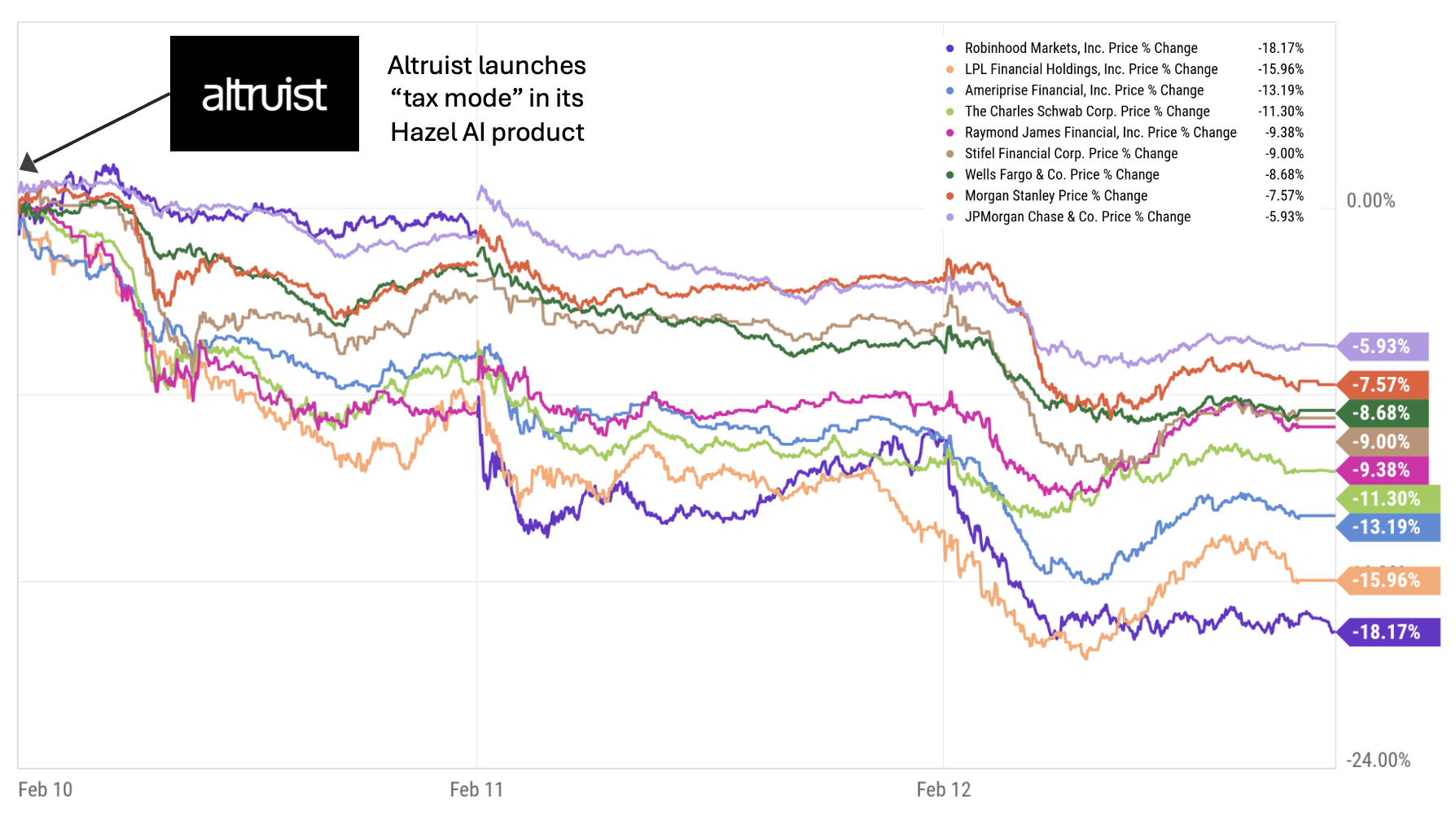
Jason turned out to be absolutely right. Over the next eight years, Altruist went from a far-fetched idea to a hugely popular innovation among smaller RIAs to a clearly superior technology platform that was moving rapidly upmarket. If there was a moment signaling the inevitability of Altruist’s winning approach, it came on February 10, 2026, when Altruist introduced a powerful tax planning agent into its Hazel AI platform. The agent’s capabilities far exceeded what the markets thought was possible with AI, and public wealth management stocks promptly lost $130 billion in market value, which McKinsey dubbed “the Altruist moment.”
Lessons Learned
Of the many lessons we’ve learned or had reinforced along the way with Altruist, here are some I would highlight that may be helpful for other entrepreneurs:
1. The entrepreneur is more than half the ballgame: Jason is an extraordinary and unique individual, and I’m not sure anyone else could have pulled off what he did with Altruist. He had been in the wealth management industry his entire career and had founded two successful startups before Altruist and so was a seasoned entrepreneur in the industry. He was a software developer who became a financial advisor and consequently not only understood his customers’ technology needs natively, but understood how vertical integration and AI could change the wealth management industry at a level others couldn’t. He had generated a huge following among financial advisors because they viewed him as one of their own who understood their problems and could credibly help them.
2. Vertical integration is a formidable strategy in a commoditizing industry with complex infrastructure: Altruist’s vertical integration strategy makes its products radically easier to use than alternatives, enables it to offer capabilities that others cannot and allows it to charge less than competitors at each layer of its stack while earning more per advisor across them. As with Toast, Shopify and other analogs, vertical integration also creates significant defensibility from competitors at any individual layer of the stack.
3. Don’t be afraid to go after the deepest layers of financial infrastructure: This is often where the most obsolete and inflexible technology resides and where the upside to providing a more advanced alternative is highest. The key is finding the right initial customer segments, which in the case of Altruist were small RIAs that most existing custodians preferred to ignore and whose needs were simplest. As Altruist added more functionality, it was able to move upmarket and serve larger and more complex RIAs.
4. Developing core data infrastructure confers significant AI application benefits: Developing a far more advanced custody platform gave Altruist significant advantages in building AI applications that sit on top of it and use its data. The first application was tax planning, but as Jason has indicated publicly, Altruist will soon offer financial and estate planning and will likely offer other significant RIA applications in the future.
5. Don’t be afraid to take on monopolies/duopolies: Some early Altruist skeptics in the trade press thought there was no way a small startup could meaningfully take on the Schwab/Fidelity duopoly in RIA custody, but they turned out to be dead wrong. It’s precisely where there are duopolies or monopolies that service levels drop, innovation slows to a crawl and customers are left unhappy. One of the most interesting aspects of Altruist’s success is the exceptional level of customer love it enjoyed. It seemed that all RIAs wanted it to succeed, even if they weren’t yet customers. In the latest T3 survey, Altruist ranked as the #1 custodian, significantly beating Schwab and Fidelity in customer satisfaction. Market share will increasingly follow.
6. Understand the geopolitics of your industry: Every industry has a complex set of competing interests and a set of players who are natural allies for startups and can make things happen for them under the right circumstances. Asset managers, like RIAs, were broadly cheering for Altruist’s success, particularly after the acquisition by Schwab of TD Ameritrade. Vanguard has a significant set of overlapping interests and unusually deep mission alignment with Altruist. It has been a helpful big brother to Altruist from the company’s early days.
7. Build your board well early: For most startups, building out one’s board of directors often gets punted to the later stages of growth. If you can add outstanding board members early, however, it can provide huge advantages. In 2020, when Altruist was still in its second year of operation and before Vanguard had gotten to know the company, we introduced Jason to Bill McNabb, the former Chairman and CEO of Vanguard, as someone who could potentially be a great mentor and advisor or director. Jason thought Bill was terrific and invited him to join Altruist’s board. Bill has been exceptionally helpful to Jason, the senior team and board across every aspect of the business and has been an outstanding advisor on how to navigate the industry. Bringing him on early made a big difference and enabled him to have a bigger impact.